
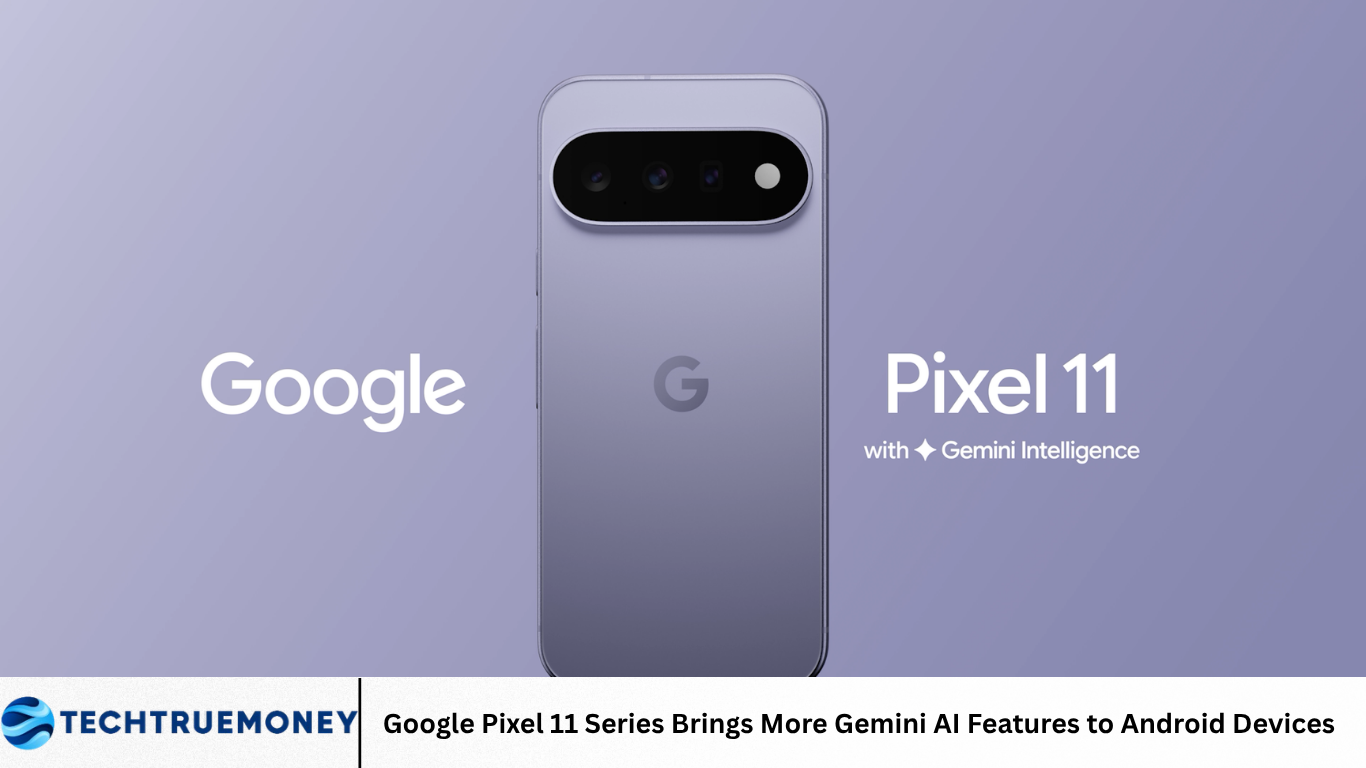
Artificial intelligence is becoming an increasingly important part of the smartphone experience. From helping users write messages to organizing information and answering everyday questions, AI tools are changing how people interact with their devices. Google has been building these capabilities into Android through Gemini, its AI assistant designed to help users complete tasks, find information, and work more efficiently.
The Google Pixel 11 series represents the next stage of Google’s smartphone strategy, with growing attention on AI-powered experiences across Android. The Pixel lineup has traditionally highlighted Google’s software, camera technology, and close integration with Android services. AI adds another layer to this approach by connecting smartphone features with tools that can understand requests, process information, and assist with everyday activities.
Google’s Growing Focus on Smartphone AI
Google has been investing in artificial intelligence across its products, including Search, Gmail, Photos, Maps, and Android. Gemini is a central part of this strategy because it can help users perform different tasks through natural language instructions.
Instead of navigating several menus, users can ask an AI assistant to explain information, summarize text, help draft a message, or provide guidance on a particular subject. The assistant can interpret requests written in everyday language, making the technology easier to use for people who are not familiar with advanced software tools.
Smartphones are a natural place for these features because people carry them throughout the day. A phone can contain messages, photographs, documents, calendar events, and other information that users may need to access quickly. AI can help make these resources easier to understand and manage when the relevant permissions and integrations are available.
Google’s Pixel devices are particularly important to this approach because the company develops both Android software and Pixel hardware. This relationship gives Google an opportunity to design features around the capabilities of its own devices and introduce software experiences that may later reach other Android phones.
The Pixel 11 series fits into this wider direction by placing continued attention on the relationship between smartphone hardware, Android software, and Gemini-powered assistance.
How Gemini Could Improve Everyday Smartphone Use
One of the biggest advantages of AI assistants is their ability to help with ordinary tasks. Many smartphone activities involve reading, writing, searching, and organizing information. Gemini can assist with these activities by interpreting instructions and generating responses based on the information available to it.
For example, users may ask Gemini to explain a complicated message in simpler language, prepare a first draft of an email, or summarize a lengthy document. These functions can reduce the time spent handling routine work, particularly for people who frequently use their phones for communication and productivity.
AI assistance can also help users explore unfamiliar subjects. Someone planning a trip might ask for an overview of a destination, while a student could request an explanation of a difficult concept. The usefulness of the response depends on the quality of the information, the user’s instructions, and the assistant’s ability to recognize when it lacks reliable details.
A more integrated Gemini experience could make these tasks easier to access from a Pixel phone. However, users should not assume that every feature is exclusive to the Pixel 11 series or available on every Android device. Google’s AI tools may vary according to the model, software version, account type, language, and region.
The main goal is to make digital assistance more practical without requiring users to learn complicated commands or switch constantly between applications.
AI Features and the Future of Android
Android supports a wide range of smartphones made by different manufacturers. Google must therefore balance the development of advanced AI capabilities with the need to make Android useful across devices with different hardware specifications.
Some AI features can operate through cloud-based systems, while others may use processing power available directly on a smartphone. These approaches have different advantages. Cloud processing can provide access to powerful models, while on-device processing may offer faster responses for supported tasks and reduce the need to send certain information to remote servers.
The availability of on-device AI depends on factors such as the phone’s processor, memory, software optimization, and the requirements of the particular model. Not every AI function can run locally, and some tasks may still require an internet connection.
Google’s Pixel devices provide a platform for demonstrating how these technologies can work together. By designing hardware and software with AI in mind, the company can attempt to make assistance more responsive and better integrated with the operating system.
At the same time, Google must consider battery consumption, device temperature, performance, and storage requirements. AI features should improve the smartphone experience rather than make everyday activities slower or more complicated.
Gemini Could Make Smartphone Photography More Flexible
Photography has long been one of the main strengths of Google’s Pixel lineup. The company has used computational photography to improve images through software processing, allowing its phones to produce detailed photographs in a variety of lighting conditions.
Artificial intelligence can support photography in several ways. Image-processing systems can help balance lighting, reduce noise, improve detail, and combine information from multiple camera captures. AI-powered editing tools can also help users adjust photographs or make selected changes after taking a picture.
Gemini-related capabilities could complement this broader approach by helping users understand, organize, or work with visual information. For example, AI tools may be able to answer questions about an image or assist with tasks connected to photographs when the required functionality is supported.
However, image editing and visual understanding are not identical to traditional camera improvements. A smartphone may have excellent image-processing software without offering every AI feature associated with Google’s wider services.
Consumers should therefore examine the actual camera specifications and available software tools when comparing Pixel models. Camera sensors, lenses, image processing, low-light performance, and video recording remain important factors alongside AI features.
The best smartphone photography experience comes from a combination of dependable hardware and software that produces consistent results.
Writing and Communication Could Become Easier
Writing assistance is another area where Gemini can provide practical value. Many people use their smartphones to respond to messages, write emails, prepare notes, and communicate with colleagues or customers.
AI tools can help create an initial draft, adjust the tone of a message, shorten a long explanation, or make a paragraph easier to understand. These capabilities may be useful when users need to communicate clearly but have limited time to write everything from scratch.
For example, a user could request a polite response to a professional message or ask for a shorter version of a lengthy explanation. Gemini can generate a starting point that the user can review and edit before sending.
The same approach can help with planning and personal organization. Users may ask for ideas, request a summary of information, or use supported integrations to help manage certain tasks.
Still, AI-generated text should not always be treated as ready to send. The assistant may misunderstand context, produce incorrect information, or use a tone that does not match the situation. Users should review important messages, especially those involving work, financial matters, legal issues, or sensitive personal information.
If Google continues improving how Gemini works across Android, these writing tools could become more convenient to access within supported applications and workflows.
Personal Assistance and Contextual Help
A major goal for AI assistants is to provide help that is relevant to what a user is doing at a particular moment. Instead of answering isolated questions, an assistant may be able to support a sequence of related tasks.
For instance, someone organizing a meeting might need help preparing an agenda, drafting an invitation, and summarizing background information. A capable assistant can help with individual steps and, where supported integrations exist, reduce the effort required to move between them.
Contextual assistance can also make phones easier to use. Users may want an explanation of a setting, help understanding a notification, or guidance on completing an unfamiliar task. Natural language can make these interactions more accessible than searching through technical menus.
However, access to personal information must be handled carefully. Features that work with messages, calendars, photographs, or other private content may require specific permissions. Their availability can also depend on the applications involved and the user’s settings.
Google must ensure that users understand what information an AI assistant can access and how that information is processed. Clear controls are essential if AI is going to become more deeply integrated into personal devices.
For Pixel 11 owners, the value of these features will depend on how well they work in real situations and whether users feel comfortable relying on them.
Privacy and Security Remain Important
As AI becomes more closely connected to smartphone activities, privacy and security are becoming central concerns. A smartphone often contains sensitive information, including private conversations, photographs, work documents, location data, and account details.
Users need to understand whether an AI feature processes information on the device or sends it to a cloud service. The answer may differ according to the feature and its technical requirements.
On-device processing can reduce the amount of information that needs to leave a phone for certain tasks. Cloud-based systems, however, may be necessary for more demanding functions. In either case, privacy depends on implementation, data handling practices, account settings, and the permissions granted by the user.
AI assistants also introduce new security challenges. A system may misunderstand an instruction, generate inaccurate information, or be influenced by misleading content. When an assistant interacts with connected applications, careful permission controls become particularly important.
Users should avoid sharing passwords, financial credentials, and other highly sensitive information unnecessarily. They should also review application permissions and check the privacy settings associated with AI services.
Google’s long-term success with Gemini will depend not only on how capable the technology becomes but also on whether users trust it with their everyday digital activities.
Performance and Battery Life Matter
AI features can demand significant computing resources. Tasks involving image processing, speech recognition, and advanced language models may require substantial processing power, memory, or network access.
For smartphone manufacturers, this creates a challenge. They need to provide useful AI capabilities while maintaining responsive performance and acceptable battery life.
A feature that produces an impressive result but drains the battery quickly may not be convenient for everyday use. Similarly, an AI assistant that responds slowly or struggles with simple requests may discourage users from relying on it.
Hardware design plays an important role in addressing these issues. Processors with dedicated AI capabilities can accelerate certain workloads, while software optimization can help distribute tasks efficiently between the device and cloud services.
However, the presence of an AI-focused processor does not automatically guarantee that every AI feature will be faster or more efficient. Results depend on the specific software, model, and task.
When evaluating the Pixel 11 series, consumers should consider battery endurance, charging speed, general performance, and software support alongside advertised AI capabilities. These everyday factors can have a greater impact on satisfaction than a long list of experimental features.
How Pixel AI Compares With Other Android Phones
The Android market includes devices from manufacturers such as Samsung, Xiaomi, OnePlus, and others. These companies are also exploring ways to integrate AI into photography, communication, productivity, and system features.
Competition encourages manufacturers to develop useful tools, but it also makes it harder for any single company to stand out through AI alone. Many smartphones now offer some form of intelligent image editing, writing assistance, translation, or voice-based interaction.
Google’s advantage comes partly from its position as the developer of Android and its experience with search, language models, and other AI services. Pixel devices can showcase Google’s preferred approach to integrating these technologies with the operating system.
Other manufacturers may offer different advantages, including hardware variety, charging technology, design options, display features, or specialized software tools. The best choice will depend on the user’s priorities rather than the number of AI features listed in a product description.
Consumers should also check whether a particular Gemini capability requires a subscription, a supported Google account, an internet connection, or a specific software version. Some features may be available on multiple Android devices, while others may require particular hardware.
As competition increases, manufacturers will need to demonstrate that their AI tools provide clear benefits rather than simply adding complexity to the user experience.
The Importance of Software Updates
Smartphone software does not remain fixed at the time of purchase. Updates can introduce new features, improve performance, address security problems, and change how existing applications work.
AI services are especially likely to evolve because their capabilities depend on both device software and the underlying AI models. A feature available today may receive improvements later, while another may remain limited to particular devices or markets.
Google’s software support is therefore an important consideration for Pixel buyers. Users should examine the official update policy for the specific model and understand that operating system updates, security updates, and AI feature releases may follow different schedules.
Regional availability can also affect the experience. Language support, local regulations, account eligibility, and the availability of connected services may determine whether users can access particular capabilities.
Reliable updates matter because AI tools need to be secure and dependable as well as innovative. Improvements should make the phone easier to use without introducing unnecessary complications.
For the Pixel 11 series, the long-term quality of software support may be just as important as the features available at launch.
What Consumers Should Consider Before Buying
Consumers interested in the Pixel 11 series should evaluate the complete smartphone experience rather than making a decision based entirely on Gemini. AI can be useful, but it is only one part of a phone’s overall value.
Price is an important starting point. Buyers should compare the cost of each model with its display quality, camera system, battery performance, storage capacity, and expected software support. They should also consider whether the AI features they want are available in their country and language.
Everyday usage patterns matter as well. Someone who frequently writes emails, manages documents, or uses voice assistance may benefit more from AI tools than a person who mainly uses a phone for calls, messaging, and basic browsing.
Privacy preferences should also influence the decision. Users who are uncomfortable with certain forms of cloud processing may want to investigate which features work locally and what controls are available.
Finally, buyers should check official product information before assuming that a particular feature is included. Marketing descriptions can cover a broad range of capabilities, and availability may differ by model or software release.
A good purchasing decision comes from matching real needs with verified features, not from choosing a device simply because it promotes artificial intelligence.
The Future of Gemini Across Android
Google’s wider objective is to make Gemini useful across more parts of the Android experience. Rather than limiting AI to a standalone application, the company has been working toward assistance that can support different activities across its software ecosystem.
This approach could change how people interact with smartphones. Users may increasingly describe what they want to accomplish instead of manually searching for individual functions. AI could help them understand information, prepare content, organize tasks, and work with supported applications.
However, deeper integration will require careful design. AI assistants must respect user permissions, provide accurate responses, and make it clear when they are uncertain. They also need to work consistently across different devices and software environments.
There are practical limitations to consider. AI can make mistakes, some tasks require a reliable internet connection, and advanced capabilities may not be available on every phone. These constraints mean that traditional smartphone controls and applications will remain important.
The Pixel series gives Google a platform to demonstrate how its software and hardware can work together. If the company can deliver meaningful improvements without sacrificing reliability, privacy, or battery life, Gemini could become a more useful part of everyday Android use.
Frequently Asked Questions
What is the Google Pixel 11 series?
The Google Pixel 11 series refers to Google’s Pixel smartphone lineup for that generation. Its capabilities depend on the individual models and the official hardware and software specifications released by Google.
What is Gemini on Android?
Gemini is Google’s AI assistant. It can help with tasks such as answering questions, explaining information, drafting text, and supporting certain activities through compatible applications and services.
Will Gemini features be exclusive to Pixel 11 phones?
Not necessarily. Some Gemini capabilities are available across supported Android devices, while other features may require specific hardware, software versions, accounts, or subscriptions.
Can Gemini help users with everyday tasks?
Yes. Depending on the feature and available integrations, Gemini can assist with writing, summarizing information, learning about unfamiliar subjects, and completing certain productivity tasks.
Will Pixel 11 AI features work without an internet connection?
Some AI tasks may support on-device processing, while others require an internet connection and cloud-based services. Offline availability depends on the specific feature and device.
Are Gemini AI features safe for personal information?
Safety depends on how each feature processes data, the permissions granted, and the service’s privacy controls. Users should review settings and avoid sharing sensitive information unnecessarily.
Should buyers choose a phone based mainly on AI features?
No. AI is one consideration among many. Buyers should also compare price, camera quality, battery life, performance, software support, and whether the features they need are available in their region.
Conclusion
The Google Pixel 11 series reflects the growing importance of artificial intelligence in Google’s smartphone strategy. Gemini offers opportunities to make writing, information searches, productivity, and other everyday activities more convenient, while broader Android integration could help users access assistance in more natural ways.
The success of this approach will depend on practical performance rather than promises alone. AI tools must be reliable, easy to understand, secure, and useful enough to justify their place on a smartphone. Google must also manage differences in hardware, regional availability, and software requirements.