
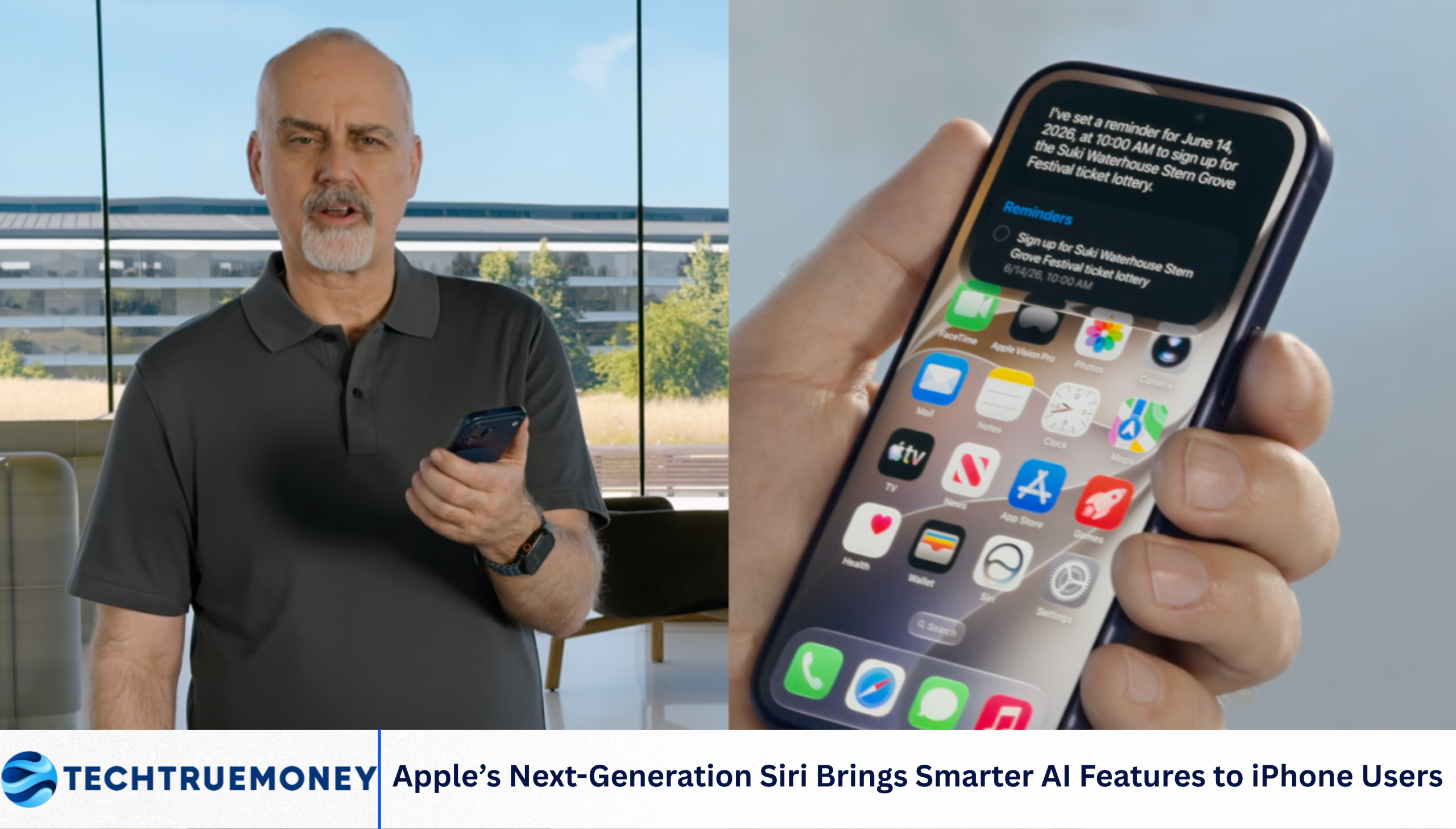
Apple is giving Siri its biggest artificial intelligence upgrade yet, turning the familiar voice assistant into a more capable and conversational tool. The new Siri AI is powered by the next generation of Apple Intelligence and is designed to understand personal context, recognize what is happening on an iPhone screen, answer broader questions, and perform actions across apps.
Apple began rolling out Siri AI as a beta with its 2027 software releases in September 2026. The first rollout is in English, with French, Japanese, Korean, Portuguese, and Spanish scheduled to follow in October. The new capabilities are available on supported Apple Intelligence devices, although availability varies by device, language, and region.
A Completely Reimagined Siri
The new Siri has been rebuilt around Apple’s latest AI architecture. Apple describes it as a more personal and capable assistant that can understand information from across a user’s device while also using broader web knowledge to answer questions.
Users can speak naturally with Siri and continue a conversation with follow-up questions. Rather than treating every request as a separate command, the system is designed to maintain more conversational context.
For example, a user could ask Siri about an upcoming trip, follow up with questions about the destination, and then ask it to help organize information across supported apps.
Apple says Siri AI can also search across messages, emails, photos, and other personal information when users ask it to find something. This personal context feature is one of the most important differences between the new Siri and earlier versions of Apple’s assistant.
Understanding Personal Context
One of the main goals of Siri AI is to make the assistant more aware of information users already have on their devices.
A user might remember receiving a restaurant recommendation from a friend but not remember the name. Instead of manually searching through old messages, the user can ask Siri to find the recommendation.
Similarly, Siri can help locate information from emails, photos, and other supported content. Apple says personal context understanding can also extend to third-party apps when developers integrate with Spotlight.
This could make Siri more useful for everyday organization because users would not always need to remember where information was stored.
The feature also demonstrates Apple’s approach to AI. Rather than making Siri simply another general-purpose chatbot, Apple is connecting its AI directly to the information and applications already available on its devices.
Onscreen Awareness Makes Siri More Useful
Another major feature is onscreen awareness.
Siri AI can understand information displayed on an iPhone screen and answer questions about it. This means users do not always have to describe what they are looking at.
For example, someone reading a message containing information about an event could ask Siri about the details. A user looking at notes, images, documents, or other content can also ask questions about what appears on the display.
Apple says Siri can also use this understanding to take actions.
This creates a more natural interaction between the assistant and the rest of the operating system. Instead of switching between applications and copying information manually, users can ask Siri to work with the content already in front of them.
Siri Can Take Action Across Apps
Apple is also giving Siri more systemwide app actions.
The company says Siri AI can help with tasks such as drafting an email, editing and sharing photos, and carrying out other actions across applications.
In one example, Apple shows Siri finding upcoming home games for a sports team from a website and adding them directly to the user’s calendar.
This type of capability could be more significant than simply improving Siri’s answers.
The real benefit of an AI assistant comes from being able to complete tasks rather than only explaining how to complete them. Apple’s deeper integration with its operating systems gives Siri access to tools and applications that standalone AI chatbots may not have in the same way.
Web Knowledge for More Up-to-Date Answers
The new Siri is also designed to go beyond information stored on the user’s device.
Apple says Siri AI can use broad world knowledge and information from the web to answer questions on virtually any topic. Users can then continue the conversation with follow-up questions.
This expands Siri’s role considerably.
Older versions of Siri were often associated with relatively simple requests such as setting timers, checking weather, making calls, or controlling settings. The new system is intended to handle more open-ended questions and research-style requests.
For users, this means Siri can become a starting point for both device-related tasks and general information.
A New Siri App
Apple has also introduced a dedicated Siri app.
The app allows users to revisit previous conversations and start new ones. Apple says conversation history can be privately synchronized through iCloud across supported Apple devices.
This is a significant change because Siri has traditionally been experienced primarily as a voice assistant that appears temporarily when summoned.
A dedicated app gives Siri a more persistent presence.
Users can return to an earlier conversation rather than starting again from scratch. Someone might begin a discussion on an iPhone and continue it on a Mac, iPad, Apple Watch, or Apple Vision Pro.
Visual Intelligence Comes to Siri
Apple is also combining Siri with Visual Intelligence.
On iPhone, Siri’s multimodal capabilities are integrated into the Camera app through a new Siri mode. Users can point the camera at something and ask Siri questions about what they see.
This makes Siri more capable of understanding the physical world.
Instead of typing a description of an object, users can potentially show it to the assistant. Siri can then analyze the visual information and provide relevant information or actions.
Apple has also expanded Visual Intelligence to iPad, Mac, and Apple Vision Pro.
This broader availability demonstrates Apple’s move toward multimodal AI, where text, images, and other forms of information can be processed together.
Siri Can Help With Writing
The new AI capabilities also extend to writing.
Apple says Siri AI includes integrated Writing Tools that allow users to generate and refine text virtually anywhere they type. Users can describe what they want and ask Siri to create a draft or modify existing writing.
This can be useful for emails, messages, notes, and other everyday communication.
Instead of opening a separate AI writing application, users can use Apple’s AI features within the existing system.
The approach reflects Apple’s broader strategy of integrating AI into the operating system rather than treating it as a separate destination.
More Natural Conversations
Conversation quality is another area where Apple is trying to improve Siri.
The new assistant is designed to support richer back-and-forth interactions. Users can ask follow-up questions rather than repeating the entire request each time.
Apple also says Siri AI provides more expressive voices. On devices supporting Apple’s advanced on-device model, users can customize the expressiveness and pace of Siri’s voice.
Improved speech understanding is also intended to make natural spoken requests easier to handle.
This could make Siri more useful for people who prefer talking instead of typing.
Improved Dictation
The same AI architecture is being used to improve systemwide dictation.
Apple says the updated system can automatically handle capitalization, punctuation, and formatting while converting speech into text.
This could benefit users who frequently dictate messages, emails, notes, or longer documents.
Better speech recognition is particularly important for an assistant because users expect voice commands to work without carefully choosing specific phrases.
The goal is to make interaction feel more like normal conversation.
Privacy Remains Central
Apple is emphasizing privacy as it expands Siri’s AI capabilities.
The company says the new architecture uses both on-device models and Private Cloud Compute for more demanding requests. Apple says that when Private Cloud Compute handles a request, personal data is not stored or made accessible to Apple.
The company also says its privacy architecture can be reviewed by outside experts.
This is particularly important because the new Siri has access to more personal context than previous versions.
An assistant that can search messages, emails, photos, and other information needs strong controls around how that information is processed.
Apple’s strategy is to keep as much processing as possible on the device while using private cloud computing when additional processing power is needed.
Which iPhones Support the New Siri?
Siri AI is not available on every iPhone.
Apple says Apple Intelligence and Siri AI require supported hardware. Compatible devices include iPhone 15 Pro and iPhone 15 Pro Max, along with iPhone 16 models and later. Other supported Apple devices include certain iPads and Macs with Apple silicon.
This hardware requirement means some older iPhones will not receive the full set of new AI capabilities.
The reason is closely connected to Apple’s use of advanced on-device AI models. Newer chips provide the processing capabilities needed for these features.
For existing iPhone owners, device compatibility will therefore be an important factor when considering Apple’s latest Siri experience.
Language and Regional Availability
The rollout is also taking place in stages.
Apple says Siri AI is initially available in English as a beta. French, Japanese, Korean, Portuguese, and Spanish support is expected in October 2026.
Availability can also differ by region.
Apple says Siri AI will not initially be available on iOS in the European Union, although Mac and Apple Vision Pro users in the EU can access Siri AI when using a supported language. Apple says it is working on bringing the feature to additional Apple platforms while addressing privacy and regulatory requirements.
This means users in different countries may have different access to Apple’s newest AI capabilities.
Siri Across the Apple Ecosystem
Apple is not limiting the new Siri experience to the iPhone.
Siri AI is deeply integrated into iPhone, iPad, Mac, Apple Watch, and Apple Vision Pro. The assistant can therefore follow users across different devices.
This is an important part of Apple’s strategy.
A person might start a conversation on an iPhone, continue it on a Mac, and later access it from an Apple Watch.
The dedicated Siri app and iCloud synchronization are designed to make these transitions easier.
Apple’s hardware ecosystem gives it an advantage in this area because the company controls both the operating systems and the devices on which the AI assistant operates.
Siri and the Competition
The AI assistant market has changed significantly as systems such as ChatGPT, Gemini, and other AI platforms have become more capable.
Consumers increasingly expect digital assistants to understand natural language, maintain context, analyze images, answer complex questions, and perform tasks.
Apple’s new Siri reflects this changing expectation.
Rather than competing only as a traditional voice assistant, Siri is becoming a more general AI interface for Apple’s ecosystem.
The difference is that Apple can connect the assistant directly to system functions, personal information, applications, cameras, and hardware features.
AI Could Change How People Use iPhones
If Siri AI works as Apple intends, it could change the way people interact with their iPhones.
Users may not need to open an application for every task. Instead, they could describe what they want and allow Siri to coordinate different functions.
For example, a user could ask Siri to find information from a message, prepare an email, create a calendar event, or work with an image.
This could reduce the number of steps required for everyday tasks.
The long-term impact will depend on how reliably Siri performs these actions and how many third-party applications support Apple’s AI capabilities.
Developers Have an Important Role
Third-party developers will also influence how useful Siri becomes.
Apple says personal context understanding can extend to third-party apps when developers integrate with Spotlight.
Broader developer support could allow Siri to interact with more applications and services.
For example, an AI assistant becomes more useful if it can work with a wide range of productivity, travel, shopping, communication, and entertainment applications.
Apple’s control over its software ecosystem gives developers a framework for building these integrations.
The Importance of Reliability
Advanced AI features also bring new challenges.
The more tasks Siri is asked to perform, the more important accuracy becomes.
A small mistake in a casual conversation may not matter much. But an incorrect action involving an email, calendar appointment, file, or personal information could create problems.
Users will therefore expect Siri to understand requests correctly and ask for clarification when necessary.
The beta rollout gives Apple an opportunity to improve the system based on real-world use.
Siri Is Becoming More Than a Voice Assistant
The biggest change may be conceptual.
Siri is no longer being presented simply as a voice-controlled assistant. Apple’s latest version combines conversational AI, personal context, web knowledge, visual understanding, app actions, writing tools, and device integration.
That makes Siri closer to an AI operating-system interface.
Instead of thinking about Siri as something that answers occasional questions, users could eventually treat it as a way to interact with multiple parts of their digital lives.
This is one of the most important changes Apple has made to Siri since its introduction.
What the Future Could Bring
Apple’s current Siri AI features are only part of the company’s broader AI strategy.
As models improve and developers create deeper integrations, Siri could become capable of handling increasingly complex tasks.
Future versions could potentially coordinate more applications, understand longer conversations, and provide more personalized assistance while keeping Apple’s privacy architecture at the center.
The challenge will be balancing usefulness with control.
Users want AI that can do more, but they also need to understand what the system is accessing and what actions it is taking.
Apple’s ability to maintain that balance will be an important part of Siri’s future.
The success of the new Siri will ultimately depend on reliability, developer support, device compatibility, privacy, and how naturally people can use the system. But Apple’s latest update clearly moves Siri toward a new generation of AI-powered personal assistance.
Frequently Asked Questions
What is the new Siri AI?
Siri AI is Apple’s redesigned version of Siri powered by the next generation of Apple Intelligence. It adds personal context understanding, onscreen awareness, broader web knowledge, visual capabilities, and more systemwide actions.
Which iPhones support Siri AI?
Apple says Siri AI is available on Apple Intelligence-enabled iPhone 15 Pro and iPhone 15 Pro Max models and iPhone 16 models or later, with availability depending on software, language, and region.
Can Siri understand what is on my iPhone screen?
Yes. Siri AI can use onscreen awareness to answer questions about content displayed on a supported iPhone screen and can use Visual Intelligence to understand visual information.
Can the new Siri search my messages and emails?
Yes. Apple says Siri AI can use personal context understanding to find relevant information across messages, emails, photos, and other supported content.
Is the new Siri available now?
Yes. Apple began rolling out Siri AI as a beta with its September 2026 software releases, initially in English. Additional language support, including Spanish, French, Japanese, Korean, and Portuguese, is planned for October 2026.
Conclusion
Apple’s next-generation Siri represents a major change in how the iPhone’s digital assistant works. Powered by the latest Apple Intelligence technology, Siri AI can understand personal context, analyze information on the screen, answer broader questions using web information, and perform actions across supported apps.
The new Siri also adds Visual Intelligence, improved dictation, more expressive voices, a dedicated Siri app, and deeper integration across Apple’s device ecosystem.