
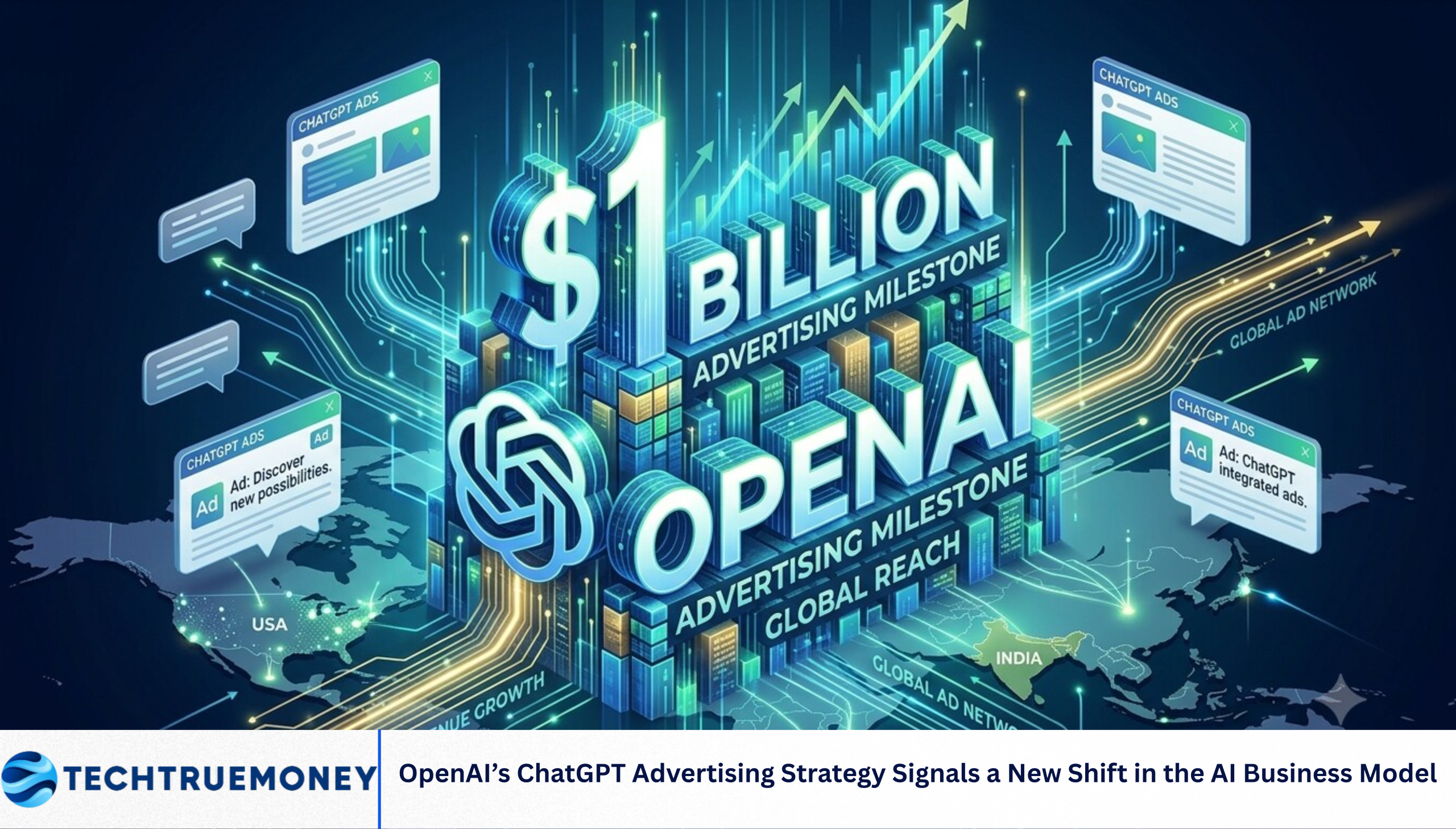
OpenAI is changing the way it approaches the business of artificial intelligence as advertising becomes an increasingly important part of ChatGPT’s revenue strategy. The company has been expanding ChatGPT Ads across more markets while continuing to build its subscription, enterprise, and API businesses.
The move represents a broader change in how AI services can generate revenue. Instead of relying mainly on paid subscriptions and business customers, OpenAI is using advertising to support free and lower-cost access to ChatGPT. In August 2026, OpenAI said ChatGPT Ads had reached a $1 billion annualized revenue run rate less than 200 days after launch, with tens of thousands of advertisers using the platform.
Why OpenAI Is Turning to Advertising
Building and operating advanced AI systems requires significant computing infrastructure, research investment, data processing, and other resources. OpenAI has developed several revenue streams to help support those costs, including consumer subscriptions, enterprise services, and usage-based API products.
Advertising adds another source of revenue. OpenAI says advertising can help support broader access to ChatGPT while allowing users on free and lower-cost plans to use the service without paying a traditional subscription fee.
This approach is important because many people may want to use advanced AI tools but may not want to pay a monthly subscription. An advertising-supported model allows companies to generate revenue from some users while keeping access available to a larger audience.
OpenAI has positioned advertising as one part of a diversified business model rather than as a replacement for subscriptions and enterprise services.
ChatGPT Ads Work Differently From Traditional Advertising
Traditional digital advertising often depends heavily on keywords, websites, search queries, or user interests. ChatGPT creates a different environment because users can explain their needs in a much more detailed way.
For example, a person might ask ChatGPT to compare laptops for video editing, find software for a small business, plan a home renovation, or explore products for a particular hobby.
OpenAI says its advertising platform is designed around these moments when people are exploring options, comparing alternatives, and making decisions. The company describes this as AI-native advertising, where conversational context can help determine which advertisements are relevant.
This could give advertisers a new way to reach consumers who are already researching a potential purchase.
Ads Are Separate From ChatGPT Answers
One of the most important parts of OpenAI’s advertising strategy is the separation between advertisements and ChatGPT responses.
OpenAI says ads are clearly labeled and placed separately from ChatGPT’s answers. The company also states that advertisers cannot influence, rank, or modify the answers generated by ChatGPT.
This distinction matters because users may rely on ChatGPT for product research, business decisions, education, and other important tasks. If advertising were allowed to directly determine an answer, users could have difficulty distinguishing independent information from paid promotion.
OpenAI has therefore said that advertisements should remain separate from the model’s responses.
Who Can See ChatGPT Ads?
OpenAI’s current advertising approach focuses on free and Go users. Ads may appear for people using those plans, while Plus, Pro, Business, Enterprise, and Edu accounts do not have ads. OpenAI also says advertisements are not shown to accounts identified as belonging to users under 18.
This creates a clear distinction between advertising-supported and paid experiences.
The model gives users different ways to access ChatGPT. People who do not want advertisements can use eligible paid plans, while those who prefer free or lower-cost access may see advertising.
This structure resembles a model already familiar from other internet services, although the conversational nature of AI creates new opportunities and challenges.
OpenAI Is Expanding ChatGPT Ads Globally
OpenAI began testing advertisements in the United States in February 2026. The company then expanded the program to additional markets, including Canada, Australia, New Zealand, the United Kingdom, Mexico, Brazil, Japan, and South Korea.
In August 2026, OpenAI announced that ChatGPT Ads was expanding to 31 European markets. The company said self-service advertising through Ads Manager was subsequently made available across those markets.
The European expansion is significant because it brings the advertising platform to a much larger international audience.
OpenAI has also said advertisers can now purchase ChatGPT Ads directly through its advertising tools in regions including India, Europe, the Middle East, and North Africa.
A New Opportunity for Businesses
For businesses, ChatGPT Ads offer a different way to reach potential customers.
A traditional advertisement might appear because a person searched for a particular keyword. In ChatGPT, an advertisement can potentially appear while a user is discussing a broader goal or considering several options.
This could be especially useful for products that require research before purchase.
A consumer choosing a laptop, software service, travel product, home appliance, or educational platform may spend time comparing different options. Advertising inside that research process gives businesses an opportunity to introduce their products when the user is already considering a purchase.
OpenAI’s advertising platform is designed to support campaigns based on impressions, clicks, and conversion goals. The company has also introduced additional measurement and targeting tools as the platform has developed.
AI Could Change the Way Advertising Is Created
OpenAI is also using AI to make advertising itself easier to create.
In September 2026, the company announced new AI-powered advertising features, including tools that allow businesses to create ads with prompts in ChatGPT Work. OpenAI also introduced new creative tools in Ads Manager.
This could reduce some of the work traditionally required to create advertising campaigns.
Businesses may be able to use AI to develop advertising copy, creative ideas, campaign variations, and other materials more quickly. Smaller companies could benefit because they may not have the same marketing resources as large corporations.
OpenAI has also introduced integrations with HubSpot and Shopify as part of its expanding advertising platform.
Sponsored Agents Could Make Ads More Interactive
Another major development is OpenAI’s work on Sponsored Agents.
According to OpenAI, Sponsored Agents allow users to begin a conversation with a business-sponsored agent after clicking an advertisement in ChatGPT.
This creates a potential shift from traditional advertising toward interactive commercial experiences.
Instead of simply seeing an advertisement and visiting a website, a user could potentially continue asking questions about a product or service through a sponsored experience.
For businesses, this could make advertisements more useful during the research stage. Consumers could potentially ask questions, explore features, and learn more before deciding whether to visit a company’s website or make a purchase.
The technology is still developing, so its long-term impact on advertising remains to be seen.
Privacy Remains a Major Issue
Advertising inside an AI assistant raises important questions about privacy because conversations can contain much more context than traditional search queries.
A user may tell ChatGPT about their budget, preferences, plans, work, interests, or other personal circumstances.
OpenAI says advertisers do not receive users’ conversations, chat history, memories, names, email addresses, precise locations, IP addresses, or sensitive information. The company also says conversations are kept private from advertisers.
At the same time, OpenAI says its advertising system can use signals within ChatGPT to help make ads relevant. Depending on settings, these can include the current conversation and, when personalized advertising is enabled, certain signals from a user’s broader ChatGPT experience.
This makes transparency and user controls important parts of the advertising model.
The Difference Between Personalization and Privacy
Personalized advertising is designed to make advertisements more relevant to individual users. However, personalization also creates questions about how much information should be used to select advertisements.
OpenAI says users have control over advertising personalization and that people can manage their advertising data. The company has also emphasized that advertisers do not receive the underlying personal conversation data used to determine ad relevance.
The distinction is important. An advertising system can use information internally to determine relevance without giving that information directly to advertisers.
How users understand and respond to these controls will likely remain an important part of the future development of ChatGPT Ads.
What the Advertising Model Means for Free Users
The biggest potential benefit of advertising is that it can help support broader access to AI.
Advanced AI services can be expensive to operate, particularly as millions or billions of people use them. Advertising can provide another way to generate revenue without requiring every user to pay a subscription.
OpenAI has specifically described advertising as a way to support free and lower-cost access to ChatGPT.
This means the advertising model is closely connected to OpenAI’s strategy for expanding the number of people who can use its AI services.
The company said in August 2026 that ChatGPT had more than 1 billion weekly active users and that advertising was one part of its broader revenue model.
The Impact on the AI Industry
OpenAI’s advertising strategy could influence the wider AI industry.
Other AI companies are also looking for sustainable ways to pay for computing, research, infrastructure, and product development. Subscription plans can generate revenue from paying customers, while enterprise products can generate significant business income. Advertising offers another potential path.
If AI assistants become a major way people discover information and products, advertising inside those assistants could become an important digital marketing channel.
This could eventually change how companies think about search engine optimization, product discovery, digital marketing, and online commerce.
AI Search and Traditional Search Could Overlap
Search engines have historically been a major source of advertising revenue because people use them to find information, products, and services.
AI assistants increasingly perform similar tasks through conversational interactions.
Instead of searching for several individual pages, a user may ask an AI assistant to summarize choices, compare products, explain differences, or recommend options based on specific requirements.
That means advertising inside AI assistants could become part of the broader competition for consumer attention.
The difference is that AI systems can understand a longer conversation and respond to changing requirements during the research process.
Advertisers Are Getting More Tools
OpenAI has been expanding its advertising infrastructure beyond simple ad placement.
The company says ChatGPT Ads now support campaign management through Ads Manager, measurement tools, targeting features, and different bidding approaches. It has also expanded conversion measurement and introduced tools such as the OpenAI Pixel and Conversions API.
These developments suggest that OpenAI is building a more complete advertising ecosystem rather than simply inserting basic display advertisements into ChatGPT.
For advertisers, measurement will be particularly important. Businesses need to understand whether advertisements generate meaningful traffic, engagement, leads, or sales.
The Business Model Is Becoming More Diverse
OpenAI’s advertising push shows how the AI business model is becoming more diversified.
The company now combines consumer subscriptions, enterprise products, APIs, and advertising. Each revenue stream targets a different group of customers and serves a different purpose.
Subscriptions can provide recurring revenue from individual users. Enterprise products can serve organizations with larger AI requirements. APIs allow developers to build their own applications using OpenAI models. Advertising can generate revenue from free and lower-cost users while providing businesses with access to ChatGPT’s audience.
This combination reduces reliance on any single source of income.
Challenges Ahead for ChatGPT Ads
Despite the rapid expansion, advertising inside an AI assistant presents challenges.
User trust will be one of the most important factors. People may be comfortable seeing advertisements on a website but have different expectations when interacting with an AI assistant that appears to provide personalized answers.
The distinction between advertising and information must remain clear.
Another challenge is relevance. Too many irrelevant advertisements could reduce the usefulness of the ChatGPT experience. If advertisements become intrusive, users may become less satisfied with the service.
Privacy will also remain an important issue. AI conversations can contain much richer information than traditional advertising environments, making clear controls and transparent policies particularly important.
What the Future Could Look Like
The future of AI advertising may involve more than traditional sponsored placements.
OpenAI’s work on Sponsored Agents suggests that advertisements could become interactive experiences. Users might be able to ask questions, compare products, and continue conversations with businesses without immediately leaving the AI environment.
This could create a new category of digital commerce in which AI assistants connect consumers with businesses throughout the decision-making process.
However, the technology is still evolving. The long-term balance between advertising, user experience, privacy, and independent AI responses will become clearer as the platform expands.
Frequently Asked Questions
Why is OpenAI introducing advertisements in ChatGPT?
OpenAI says advertising can help support free and lower-cost access to ChatGPT while providing another source of revenue alongside subscriptions, enterprise products, and APIs.
Do ChatGPT ads influence the answers?
OpenAI says advertisements do not influence ChatGPT’s answers. Ads are handled separately from the chat model and are clearly labeled as sponsored content.
Which ChatGPT users can see advertisements?
Ads may appear for users on Free and Go plans. OpenAI says Plus, Pro, Business, Enterprise, and Edu accounts do not have advertisements.
Will advertisers see ChatGPT conversations?
OpenAI says advertisers do not receive users’ conversations, chat history, memories, names, email addresses, precise locations, IP addresses, or sensitive information.
How big has ChatGPT advertising become?
OpenAI said in August 2026 that ChatGPT Ads had reached a $1 billion annualized revenue run rate in less than 200 days and that tens of thousands of advertisers were using the platform.
Conclusion
OpenAI’s ChatGPT advertising strategy represents a significant development in the AI business model. Advertising is becoming another revenue stream alongside consumer subscriptions, enterprise services, and APIs, while also helping support free and lower-cost access to ChatGPT.
The company has expanded ChatGPT Ads into multiple international markets and has built tools for advertisers to create, manage, measure, and optimize campaigns. It is also experimenting with AI-powered advertising features and Sponsored Agents that could make commercial interactions more conversational.