
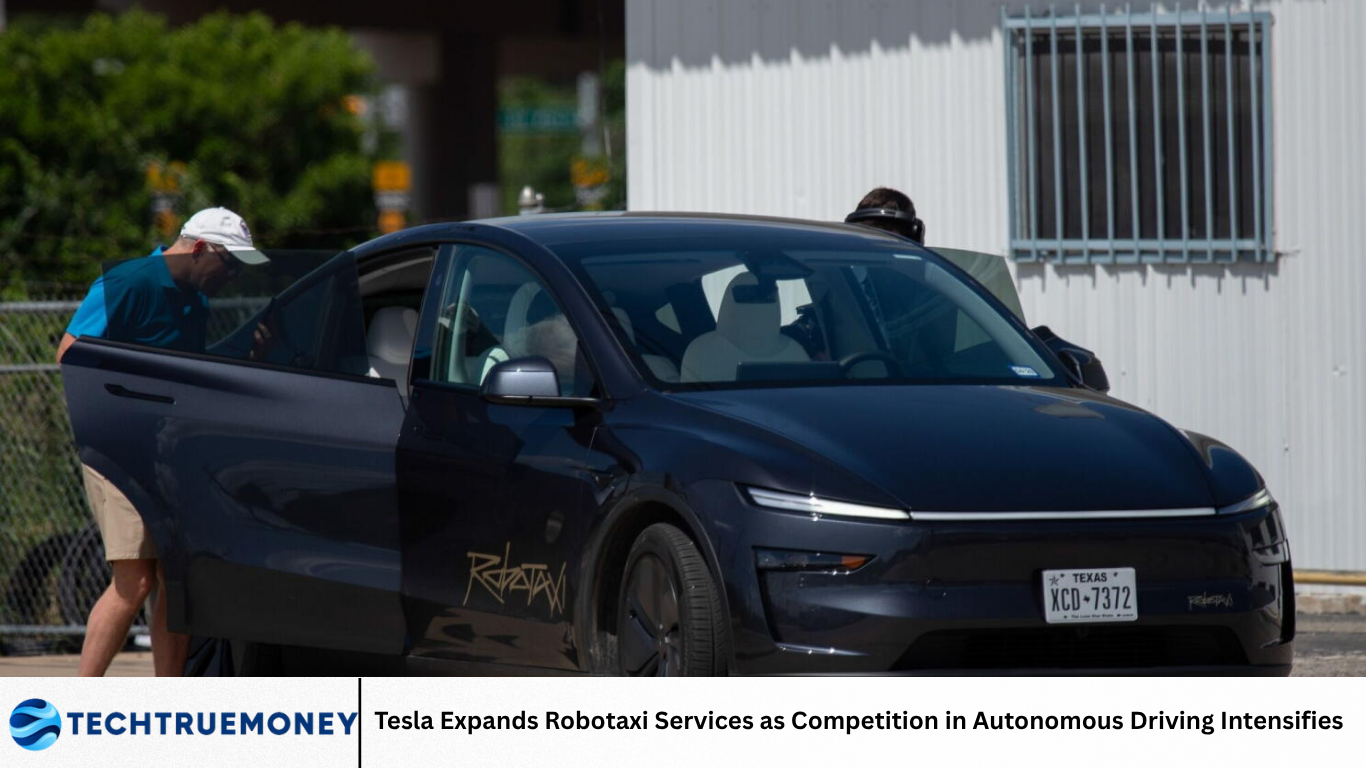
The race to develop self-driving transportation is becoming an important part of the automotive and technology industries. Companies are investing in artificial intelligence, advanced sensors, computing systems, and software designed to help vehicles navigate roads with less human involvement. Tesla is among the major companies pursuing this technology, and its robotaxi strategy reflects its ambition to expand beyond traditional electric vehicle sales.
Robotaxis are vehicles designed to provide passenger transportation using autonomous driving technology. Instead of relying on a human driver for every journey, these services aim to use automated systems to navigate routes, respond to traffic conditions, and transport passengers. Companies developing robotaxis see an opportunity to change how people travel, particularly in busy cities where ride-hailing services are already widely used.
Tesla’s Robotaxi Strategy
Tesla has spent years developing driver-assistance technology and collecting information from vehicles equipped with its software. The company believes that improvements in artificial intelligence and neural-network training can help vehicles recognize their surroundings and make driving decisions.
Robotaxis represent a potential extension of this strategy. Rather than selling vehicles only for personal use, a company could eventually operate a transportation service that connects passengers with available autonomous vehicles.
Such a model could change how vehicles are used throughout the day. A privately owned car often remains parked for long periods, while a vehicle in a commercial transportation network could potentially serve multiple passengers over a longer operating schedule.
However, this business model depends on several conditions. Vehicles must be capable of operating safely within approved areas, the service must comply with local rules, and customers must be willing to use it. The company also needs a practical system for charging, cleaning, maintaining, and monitoring its vehicles.
Tesla’s ambitions in this area are closely connected to its broader focus on software and artificial intelligence. The company sees autonomous driving as a potential source of future business value, but the commercial opportunity depends on real-world performance rather than announcements alone.
It is important to distinguish between a long-term autonomous driving vision and the capabilities of a service operating today. The level of automation, geographic coverage, and need for human supervision can vary by location and service.
How Robotaxis Work
Robotaxis combine several technologies to help a vehicle understand its surroundings and move through traffic. These systems generally use cameras or other sensors, onboard computers, maps where applicable, and software that interprets road conditions.
The vehicle must identify important objects, including pedestrians, cyclists, other cars, traffic signals, road markings, and obstacles. It then needs to estimate how those objects may move and select a suitable action.
For example, a self-driving system approaching a pedestrian crossing must recognize the crossing, determine whether someone is entering the road, and decide when to slow down or stop. In busy traffic, the vehicle may also need to account for cars changing lanes, emergency vehicles, temporary roadworks, and unexpected obstacles.
Artificial intelligence plays a major role in processing this information. Machine-learning systems can be trained using large amounts of driving data, allowing developers to improve how vehicles recognize patterns and respond to different situations.
However, road environments are complex. A vehicle may encounter unusual road layouts, poor visibility, construction zones, or behavior that differs from what its software has previously encountered. Handling these situations reliably is one of the main challenges of autonomous driving.
Robotaxi operators must therefore evaluate their systems carefully and establish procedures for situations the vehicles cannot handle confidently. Depending on the service, these procedures may involve remote assistance, a human safety operator, or restrictions that prevent the vehicle from entering certain conditions.
Competition in the Autonomous Driving Market
Tesla is not the only company working toward driverless transportation. The autonomous driving market includes technology developers, ride-hailing businesses, vehicle manufacturers, and companies focused on specialized transportation services.
Waymo, associated with Alphabet, has developed robotaxi services using its own combination of vehicles, sensors, and autonomous driving systems. Its experience operating commercial services in selected locations gives it an important position in the industry.
Other companies have also pursued autonomous mobility through different business models. Some concentrate on developing driving technology, while others collaborate with automakers or transportation operators to bring services to market.
Traditional automotive manufacturers are also interested in automation. They have experience producing vehicles at scale, managing supply chains, and providing maintenance networks. Partnerships between vehicle manufacturers and technology companies may help distribute the costs and risks associated with autonomous driving development.
Competition is not limited to the quality of driving software. Companies also compete over operating permits, service availability, passenger experience, vehicle costs, and the ability to expand into additional markets.
A technically impressive system may still struggle commercially if it is expensive to operate or difficult to deploy across different cities. Conversely, a company with a carefully controlled operating area and reliable service may build customer trust before expanding further.
Tesla’s challenge is to demonstrate that its approach can deliver a similarly dependable experience while supporting its wider vehicle business.
Artificial Intelligence Is Driving Development
Artificial intelligence is central to modern autonomous driving. Vehicles must process large amounts of information and make decisions quickly enough to respond to changing road conditions.
Developers use machine-learning techniques to improve object recognition, predict the movement of nearby road users, and select driving actions. Training systems with diverse examples can help them handle a wider range of situations.
Tesla has emphasized the role of neural networks and large-scale driving data in its approach. Information collected from vehicles can help developers identify patterns and improve software, subject to the company’s data practices and applicable requirements.
Yet more data does not automatically produce safer driving. The information must be relevant, the models must be evaluated properly, and software changes must be tested before being deployed.
AI systems can also make mistakes when they encounter unusual situations or conditions that differ from their training examples. Autonomous driving therefore requires careful testing across weather conditions, road types, traffic patterns, and unexpected events.
Developers must assess not only whether a system can complete an ordinary journey but also how it behaves when something goes wrong. A vehicle may need to slow down, stop safely, or request assistance when it cannot confidently continue.
The industry’s long-term progress will depend on combining AI development with rigorous engineering, safety testing, and clear operating procedures.
Safety Remains the Biggest Challenge
Safety is one of the most important issues facing robotaxi companies. A driverless vehicle must make decisions that protect passengers and other road users, including pedestrians and cyclists who may be difficult to detect in certain circumstances.
Human drivers can also make serious mistakes, but autonomous systems introduce different questions about responsibility, reliability, and how decisions are made. Regulators and the public need evidence that a service can operate safely under the conditions in which it is permitted to run.
Testing must cover more than routine driving. Developers need to examine how vehicles respond to emergency vehicles, temporary traffic controls, blocked roads, unusual pedestrian movements, and equipment failures.
Safety procedures should also address situations in which a vehicle cannot continue its journey. The system must be able to reach an appropriate state, such as stopping in a safe location when possible, and communicate relevant information to passengers or support staff.
Monitoring real-world performance is essential. Companies need to investigate incidents, identify recurring problems, and make improvements when evidence shows that a system requires additional safeguards.
Public trust will depend partly on transparent communication. Broad claims about autonomous capabilities are not enough; customers need to understand what the vehicle can do, where it can operate, and whether a human driver or safety operator remains involved.
For Tesla and its competitors, demonstrating consistent safety performance will be necessary for wider adoption.
Regulations Will Shape Robotaxi Expansion
Autonomous driving regulations differ across countries, states, and cities. Some jurisdictions permit certain driverless services under specific conditions, while others require additional testing, safety drivers, permits, or restrictions on where vehicles can operate.
These differences create a challenge for companies seeking to expand. A system approved for one location may not automatically be authorized to operate in another. Local road conditions, traffic laws, infrastructure, and regulatory requirements may demand further testing or changes to operating procedures.
Regulators generally need to consider vehicle safety, insurance, accident reporting, cybersecurity, passenger protection, and responsibility when something goes wrong.
Robotaxi operators must also clarify how they handle incidents and complaints. If a vehicle is involved in a collision, authorities and affected people may need access to reliable records showing what happened and how the system responded.
Rules may also determine whether a service can operate without a human safety driver. Such permissions are important because removing the need for an onboard driver is central to many robotaxi business models.
Tesla’s ability to expand will therefore depend not only on technical progress but also on its ability to meet the requirements of each market. A successful rollout requires coordination among technology developers, transportation authorities, insurance providers, and local communities.
The Business Case for Robotaxis
Robotaxis could create new revenue opportunities by allowing companies to provide transportation directly to passengers. Instead of relying entirely on vehicle sales, manufacturers and technology businesses may be able to earn money through ongoing trips and related services.
The potential economic advantage comes from vehicle utilization. A privately owned car may be used for only a small portion of the day, while a commercial vehicle could complete multiple journeys. If autonomous technology reduces operating costs sufficiently, each vehicle may become more productive.
However, this possibility depends on several expenses. Robotaxi operators must pay for vehicles, charging, cleaning, repairs, insurance, customer support, software development, and fleet management.
Autonomous systems may also require specialized monitoring and maintenance. Vehicles operating in busy cities can experience wear, damage, and downtime that reduce the number of trips they complete.
The business model must account for periods when demand is low and vehicles remain unused. Operators also need to position cars near customers without creating unnecessary travel or congestion.
Pricing is another factor. A service must be affordable enough to attract passengers while generating sufficient revenue to cover costs. Competing with human-driven ride-hailing services may be difficult if autonomous operations remain expensive.
Tesla’s long-term robotaxi opportunity will depend on whether it can combine reliable driving technology with a fleet model that works economically in real markets.
How Robotaxis Could Affect Ride-Hailing Services
Traditional ride-hailing platforms connect passengers with human drivers through mobile applications. Robotaxis could eventually provide an alternative for certain journeys, especially in locations where autonomous vehicles can operate within approved boundaries.
For passengers, a successful service might offer convenient booking, predictable pickup arrangements, and transportation without a human driver. The experience would still depend on vehicle availability, service coverage, pricing, and reliability.
For ride-hailing companies, autonomous vehicles could change the economics of transportation. Human driver compensation is a major part of the cost of conventional ride-hailing, so removing the need for an onboard driver could reduce some expenses if the technology becomes reliable and affordable.
However, robotaxis will not necessarily replace human-driven services everywhere. Some journeys involve complicated road conditions, remote locations, unusual loading needs, or interactions that are difficult to automate.
Human drivers may continue to provide valuable services in areas where autonomous operations are restricted or uneconomical. Ride-hailing companies may also work with autonomous vehicle developers instead of competing directly with them.
The transition is therefore likely to vary by city and type of journey. Robotaxis may first become more common in carefully selected areas before expanding into more complex environments.
Consumer Trust Will Influence Adoption
Even if robotaxis become technically capable, customers must feel comfortable using them. Some passengers may welcome the convenience of a driverless service, while others may have concerns about safety, privacy, or what happens during an unexpected situation.
Clear information can help address these concerns. Customers should understand how to enter and exit the vehicle, how to contact support, and what procedures apply if the vehicle stops or encounters a problem.
Passenger experience also includes cleanliness, comfortable seating, reliable pickup times, and easy payment. A technically advanced vehicle will not attract repeat customers if the service is inconvenient.
Privacy is another important consideration. Autonomous vehicles may collect information through cameras, sensors, location systems, and software logs. Operators should explain how data is used, how long it is retained, and what safeguards protect it.
Trust can grow when companies provide consistent service and communicate honestly about limitations. Overstating what autonomous technology can do may damage confidence if passengers encounter situations the service cannot handle.
The companies that succeed may be those that combine technical capability with dependable customer support and clear safety practices.
Environmental Effects and Urban Transportation
Robotaxis may influence how cities manage transportation, but their environmental impact will depend on how the services are operated.
Electric robotaxis could reduce direct tailpipe emissions compared with conventional gasoline-powered vehicles. The overall environmental benefit, however, depends on electricity generation, vehicle manufacturing, battery production, maintenance, and the number of miles driven.
Fleet efficiency matters as well. If autonomous vehicles spend substantial time traveling without passengers, they could increase traffic and energy use rather than reduce them.
Shared rides may help improve vehicle utilization when passengers traveling in similar directions can be served efficiently. Yet the availability of shared trips depends on demand, routing, customer preferences, and service design.
Robotaxis could also influence parking needs if fewer people choose to own private cars. However, the opposite outcome is possible if convenient autonomous rides encourage more vehicle trips or increase congestion.
Cities will need to consider these effects alongside public transportation, walking, cycling, and existing ride-hailing services.
The environmental value of robotaxis should therefore be measured through real operating data rather than assumed simply because a vehicle is electric or autonomous.
Challenges That Could Slow Expansion
Despite significant investment, autonomous driving remains a difficult technology to deploy widely. Roads are unpredictable, and vehicles must deal with weather, construction, unusual traffic patterns, and other situations that may not be easily anticipated.
Expansion can also be limited by regulation. A company may have a working service in one area but need additional approvals before operating elsewhere.
High development costs are another challenge. Building and maintaining autonomous driving systems requires specialized hardware, software engineers, extensive testing, and computing resources. These costs can be difficult to recover if commercial operations grow more slowly than expected.
Customer demand is not guaranteed either. Some people may prefer traditional transportation, particularly when human-driven services are readily available at competitive prices.
Vehicle maintenance and charging introduce additional operational challenges. Fleets need suitable facilities, reliable power access, cleaning arrangements, and efficient dispatch systems.
Companies must also respond to technical failures and public concerns without compromising safety. A serious incident can lead to increased scrutiny and changes in operating conditions.
For Tesla, overcoming these obstacles will require progress across technology, business operations, and regulatory compliance. The same challenges apply to its competitors, making dependable execution a major source of competitive advantage.
What the Future May Hold for Autonomous Transportation
Autonomous transportation is likely to develop gradually rather than through a single industry-wide change. Different cities may adopt robotaxis at different rates depending on regulations, infrastructure, local demand, and the performance of available systems.
Early growth may focus on limited operating areas with conditions that are easier to manage. As technology and operational experience improve, companies may seek permission to serve additional neighborhoods and routes.
Advances in AI computing, vehicle sensors, mapping, and fleet management could support this progress. At the same time, stronger testing methods and safety requirements will remain necessary.
Tesla’s strategy is part of a broader effort to turn autonomous driving into a commercially useful service. The company has significant ambitions, but its position will depend on the capabilities it can demonstrate and the markets where it is authorized to operate.
Competition may encourage better technology and more service options, but it could also lead to consolidation if some businesses struggle to cover development and operating costs.
For consumers, the most meaningful progress will be measured by safe journeys, dependable service, reasonable prices, and clear accountability.
Frequently Asked Questions
What is a Tesla robotaxi?
A Tesla robotaxi is part of the company’s vision for using autonomous driving technology to provide passenger transportation. The capabilities and operating conditions of any available service depend on its location and level of automation.
How do robotaxis operate?
Robotaxis use automated driving systems that process information from cameras or other sensors and onboard computers. The software identifies road users, interprets traffic conditions, and determines how the vehicle should move within its permitted operating environment.
Is Tesla the only company developing robotaxis?
No. Other companies, including Waymo and various automotive and technology businesses, are developing autonomous driving systems and transportation services. Their technologies, operating areas, and business models differ.
Are robotaxis safe?
Safety depends on the vehicle’s technology, testing, operating conditions, and safeguards. No autonomous driving system should be assumed to be risk-free, and services must follow applicable safety requirements.
Could robotaxis make ride-hailing cheaper?
They could reduce some operating costs if autonomous vehicles can reliably provide rides without onboard drivers. However, vehicle costs, maintenance, insurance, charging, monitoring, and other expenses will influence the final price.
Will robotaxis replace human drivers?
Robotaxis may take on some transportation tasks, particularly in approved operating areas. Human drivers may continue to be needed for complicated journeys, locations with restrictions, and services that autonomous vehicles cannot reliably provide.
What could slow Tesla’s robotaxi expansion?
Major challenges include safety testing, regulatory approvals, technical limitations, operating expenses, customer trust, and the ability to maintain reliable service across different locations.
Conclusion
Tesla’s robotaxi strategy reflects the growing competition to develop autonomous transportation. By combining electric vehicles, AI-driven software, and a potential fleet-based business model, the company is pursuing an opportunity that could reshape parts of the mobility industry.
However, commercial success depends on more than technological ambition. Robotaxis must operate safely, meet regulatory requirements, provide a dependable passenger experience, and generate enough revenue to cover their costs.